
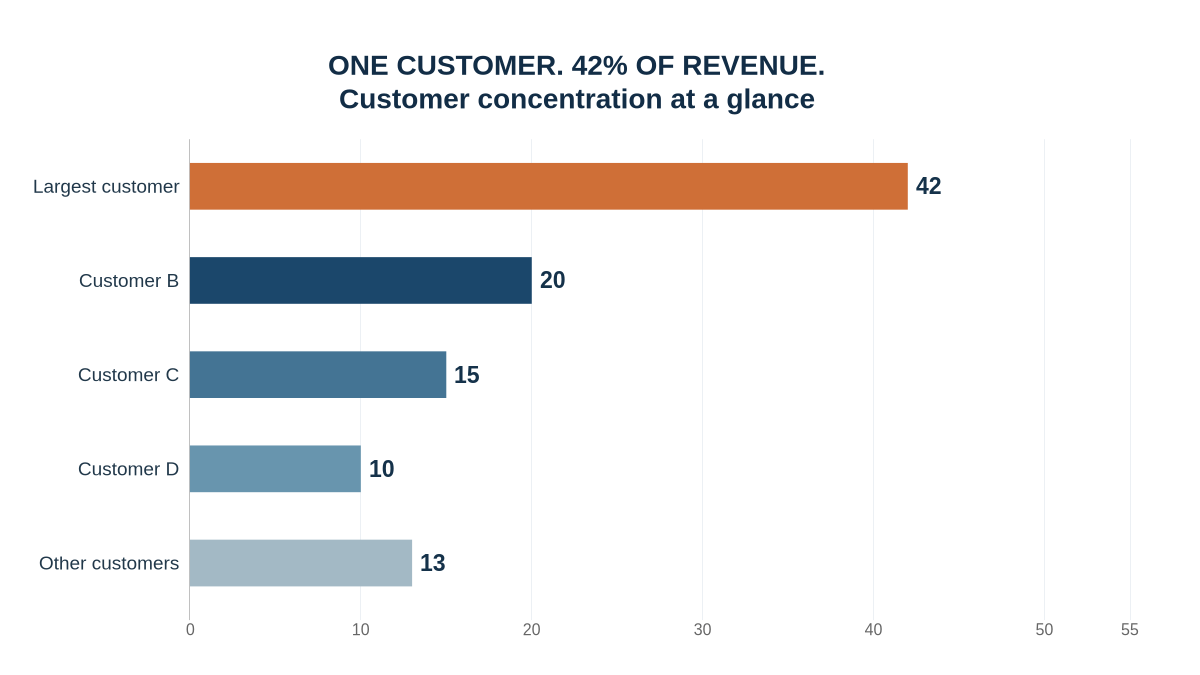
Illustrative example: one customer represents 42% of monthly revenue. The article below explains how to investigate the risk rather than assume the answer.
A small business wins a contract with a major customer. The account is worth considerably more than the company’s usual orders. Revenue grows, employees are kept busy and the owner feels that the business has reached a new level.
Two years later, the customer is still buying regularly. The relationship is good. There are no obvious complaints.
Then the customer announces that it is reviewing suppliers, reducing its budget or bringing the work in-house.
The owner suddenly faces a question that should have been answered much earlier: How much of the business actually depends on this one customer?
This is the problem of customer concentration risk. It doesn’t mean that having a large customer is bad. It means a business may become vulnerable when too much revenue, profit, capacity or cash flow depends on a small number of purchasing decisions outside its control.
The right starting point is not a rushed marketing campaign or an attempt to replace a valued customer. It is to measure the dependency and work out what would happen if the relationship changed.
Revenue can be growing while the business becomes more vulnerable
Imagine a company whose annual revenue grows from €600,000 to €900,000. On the surface, that is strong progress.
But suppose €250,000 of that increase comes from one customer. The owner is delighted with the new work, and there may be good reason to be.
What the total revenue figure doesn’t show is how much of the business’s future now rests on maintaining that one relationship.
This is one reason to look beyond turnover alone. A business can report healthy sales growth while the sources of that revenue become less diversified.
The Corporate Finance Institute explains customer concentration as the share of revenue generated by a company’s largest customers, and notes that heavy dependence can amplify risks to revenue and cash flow.
The percentage by itself, however, is only the beginning. Two businesses with the same concentration may have very different levels of risk depending on contracts, margins, payment arrangements, alternative customers and how quickly costs can be adjusted.
Start by calculating your largest customer’s share of revenue
Take your total revenue for the last 12 completed months and list the amount received or earned from each customer using a consistent accounting basis. For recurring work and seasonal businesses, a rolling 12-month period usually gives a more useful picture than a single month.
The calculation is simple:
If a business generates €1,200,000 in annual revenue and its largest customer accounts for €360,000, that customer represents 30% of annual sales.
Then calculate the combined percentage for the largest three or five customers. A business may not depend excessively on any single account but could still depend heavily on a small cluster of accounts, particularly if they operate in the same industry.
There is no single percentage at which every business becomes unsafe. Treat a high or rising concentration figure as a prompt to investigate, not an automatic instruction to refuse work.
A worked example: one customer provides 42% of revenue
Consider a hypothetical service business generating €100,000 in monthly revenue. Its sales are distributed as follows:
| Customer | Monthly revenue | Share of revenue | Gross profit contribution |
|---|---|---|---|
| Customer A — largest account | €42,000 | 42% | €14,700 |
| Customer B | €20,000 | 20% | €8,000 |
| Customer C | €15,000 | 15% | €7,500 |
| Customer D | €10,000 | 10% | €4,500 |
| Other customers combined | €13,000 | 13% | €6,500 |
| Total | €100,000 | 100% | €41,200 |
Illustrative figures only. Gross profit contributions assume different direct costs for each customer and are not actual results from a business.
Customer A represents 42% of sales, but contributes €14,700 of the business’s €41,200 monthly gross profit — about 36% of total gross profit.
That distinction matters. Revenue tells you how large the customer is; gross profit gives a clearer picture of what remains after the direct costs of serving that customer. Neither figure alone reveals what would happen to the whole business.
Suppose, for illustration, that the company also has €32,000 of monthly operating costs that would remain in place in the near term. At the current sales level, its €41,200 gross profit leaves €9,200 before other relevant adjustments.
If Customer A disappeared and the company avoided all of that customer’s direct costs, the remaining customers would generate €26,500 of gross profit. Against unchanged operating costs of €32,000, that produces a potential €5,500 monthly shortfall.
This is a stress-test scenario, not a forecast. Some operating costs might be reduced over time, other customer orders might grow, and payment timing would also affect the result. It nevertheless reveals why losing 42% of sales is not just a question of finding another 42% in new orders.
The five questions that reveal the real level of dependency
1. What happens if the customer stops ordering?
Imagine the customer places no new orders for the next three months. Which employees, premises, equipment and contractual commitments would still need to be paid? Which direct costs would disappear with the work?
The goal is to identify the financial gap you would need to cover and how much time you would have to respond.
2. What if the customer doesn’t leave, but pays late?
A large customer may account for a disproportionate share of outstanding invoices. If payment is delayed, the business may be profitable on paper but short of the cash needed for wages, suppliers or tax.
If payment timing is already putting pressure on the business, our guide to understanding why a profitable business can still run short of cash provides a practical 13-week forecasting exercise.
3. How much capacity is tied to this one relationship?
Look beyond the revenue figures. How many people spend most of their week on this customer? Have you purchased specialist equipment or hired employees mainly to fulfil its orders? Would that capacity be useful elsewhere?
A customer that keeps the business busy can be extremely valuable. But it may also limit the company’s ability to develop other profitable work.
4. How secure is the agreement really?
A long relationship is encouraging, but it isn’t the same as guaranteed future orders. Review contract renewal dates, notice periods, cancellation terms, exclusivity arrangements and any minimum purchasing commitments.
For significant contracts, have the relevant terms reviewed by a qualified professional. Do not assume that a long-term agreement guarantees the same volume of work or removes the need for contingency planning.
5. Are we protecting the relationship or becoming dependent on it?
Consider who manages the customer relationship and what happens if that person is unavailable. An account supported by a documented service process, appropriate contacts and shared organisational knowledge may be more resilient than one resting entirely on a personal connection.
A major customer can also gradually influence the way the entire business operates. Special requirements, delivery expectations or pricing concessions may become normal because nobody wants to challenge an important account.
The question is whether the relationship remains a mutually beneficial commercial arrangement or has begun to determine decisions that should be made for the wider business.
Try a one-hour customer concentration review
Start with a spreadsheet. Use actual information, not memory or estimates where records are available.
Step 1 — Find your top five customers
Export sales by customer for the last 12 completed months. Combine multiple account names where they belong to the same underlying customer or corporate group, if their purchasing decisions are effectively linked.
Step 2 — Calculate both revenue share and gross profit
For each major customer, record revenue and the direct costs reasonably attributable to fulfilling that work. Where costs are estimated or shared, label the figures accordingly.
You can start with columns like these:
| Customer | 12-month revenue | Revenue share | Gross profit | Renewal / risk note |
|---|---|---|---|---|
| Customer A | €_____ | _____% | €_____ | _____ |
| Customer B | €_____ | _____% | €_____ | _____ |
| Customer C | €_____ | _____% | €_____ | _____ |
Spreadsheet formula: For each customer, revenue share = customer revenue ÷ total revenue. Format the result as a percentage. Gross profit contribution = customer revenue − attributable direct costs. Keep the gross profit amount separate from gross margin percentage.
Step 3 — Check the biggest customer’s commercial and operational dependence
Write down what would remain if its orders fell sharply: fixed costs, specialist staff, equipment leases, outstanding invoices and commitments to suppliers.
Make a second scenario in which its orders fall by half rather than disappear completely. A partial reduction may be more realistic and can still reveal a serious weakness.
Step 4 — Identify the one exposure that deserves attention first
Do not automatically decide that you need five more customers. Look at what actually creates the greatest risk.
If the biggest issue is late payment, the priority might be improving payment terms and forecasting. If the relationship relies on one employee, it may be documenting customer knowledge and strengthening backup coverage. If orders can stop with very little notice, the priority may be a contingency plan and a more diverse sales pipeline.
Different causes require different actions. This is where investigation becomes more valuable than an automatic prescription.
Five sensible ways to reduce the risk without alienating a good customer
Protect the relationship you already have
A strong account deserves excellent service, clear communication and consistent delivery. Reducing dependence does not mean deliberately withdrawing attention or making the customer feel unwanted.
Build other business alongside it
Develop additional customers or sectors at a sustainable pace. Focus on work that fits your existing strengths and can be delivered profitably; replacing one concentrated account with several unprofitable ones is not an improvement.
Avoid new fixed commitments without testing the downside
Before taking on additional premises, equipment leases or permanent staffing specifically for a large account, test whether the business could carry those commitments if the customer’s orders reduced.
Make knowledge and delivery less person-dependent
Document the agreed service requirements, key contacts, specialist knowledge and responsibilities. Ensure that the relationship can continue if an owner or key employee is absent.
Review the figures regularly
Track the biggest customer’s share of revenue, the top five customers’ combined share, gross profit contribution and overdue receivables. The trend can tell you as much as the figure on any one date.
Businesses preparing for investment or sale may face particular scrutiny of major customer dependencies. BizBuySell’s discussion of customer concentration in business acquisitions explains why buyers examine reliance on a small number of accounts.
When one large customer is not necessarily the first problem to fix
A concentrated customer base isn’t always the most urgent issue in a business. A young company may naturally begin with a small number of customers. A specialised supplier might deliberately serve a few large organisations under established agreements.
If cash reserves are strong, the account is profitable, contracts are sound and other demand is developing, the risk may be manageable. Conversely, a business with smaller individual customers may still face urgent problems with pricing, rework, cash collection or delivery.
This is why a concentration check should lead to a prioritisation decision, not automatically to more marketing spend.
Our guide to choosing your one business priority for the next 90 days explains how to turn a diagnosis into a focused action plan rather than another collection of competing initiatives.
The question isn’t whether your biggest customer is too big
The more useful question is: If this customer changes its plans tomorrow, will your business still be able to function and make sound decisions?
A major customer may have helped your company grow, improve and employ more people. That contribution should be recognised. But the relationship also deserves a clear-eyed assessment of the dependency it has created.
Measure the revenue share. Check the gross profit and cash implications. Look at your contracts, your people and your capacity. Then select the single most significant weakness to address.
Sometimes protecting business growth isn’t about winning another big contract. It’s about making sure the business can withstand changes to the contracts it already has.
If you need a clearer picture of which issue is restricting your business, learn how a Business Growth Assessment helps identify the underlying problem that deserves attention first. To explore which business issue may matter most, see how the free Business Priority Check works; its eight-question review is a starting point, not a substitute for assessing contractual or financial exposure.
All amounts and customer scenarios in this article are illustrative, not client results. This article offers general business-management information and does not replace tailored accounting, financial or legal advice.